
If you’ve seen a headline this month telling you your CBD gummies are about to be outlawed, take a breath....
August 25, 2026

If you’ve seen a headline this month telling you your CBD gummies are about to be outlawed, take a breath. I did too — right there at my kitchen counter, coffee going cold, thumb scrolling faster than my brain could keep up. Here’s the calm version, from someone who actually read the law.
I’m going to be honest with you: the first time I read about the 2026 federal hemp ban, my stomach dropped a little. Not because of the business. Because of the small routine I’ve built around a gummy at 9 p.m., after the dishes are done and the house finally goes quiet.
So I did what I always do when something scares me on the internet. I stopped reading the headlines and went and read the actual document. And what I found was more complicated than “CBD is banned” — and, for most people reading this, a lot less frightening.
Let’s go through it together, in plain English.
The change came through the federal appropriations law signed on November 12, 2025 (Public Law 119-37). It didn’t ban a plant. It rewrote a measurement — and in this industry, the measurement is the law.
Since the 2018 Farm Bill, hemp has been defined by one number: no more than 0.3% delta-9 THC by dry weight. That single word — delta-9 — is the doorway the entire intoxicating hemp market walked through. THCA, which converts to THC when you heat it, wasn’t counted. Delta-8, made in a lab from CBD, wasn’t clearly covered either.
The new law closes that doorway three ways:
That last one is the part people keep misreading, so let me say it clearly: 0.4 mg is per container, not per serving. Not per gummy. Per jar. A single 5 mg hemp gummy is more than twelve times the limit all by itself. A twenty-count jar of them is roughly 250 times over.
“This isn’t a rule that shrinks the intoxicating hemp market. It’s a rule that ends it.”
Industrial hemp — grown for fiber, grain, seed oil, and all the non-cannabinoid uses — is explicitly protected and isn’t touched by any of this.
One more thing worth knowing, because it shapes how much hope to place in another extension: the White House has signaled through its legislative affairs office that there will be no further delays beyond the one already in the funding bill. I’d plan accordingly rather than wait for a rescue.
No. And I want to be careful here, because “no” isn’t the same as “nothing changes.”
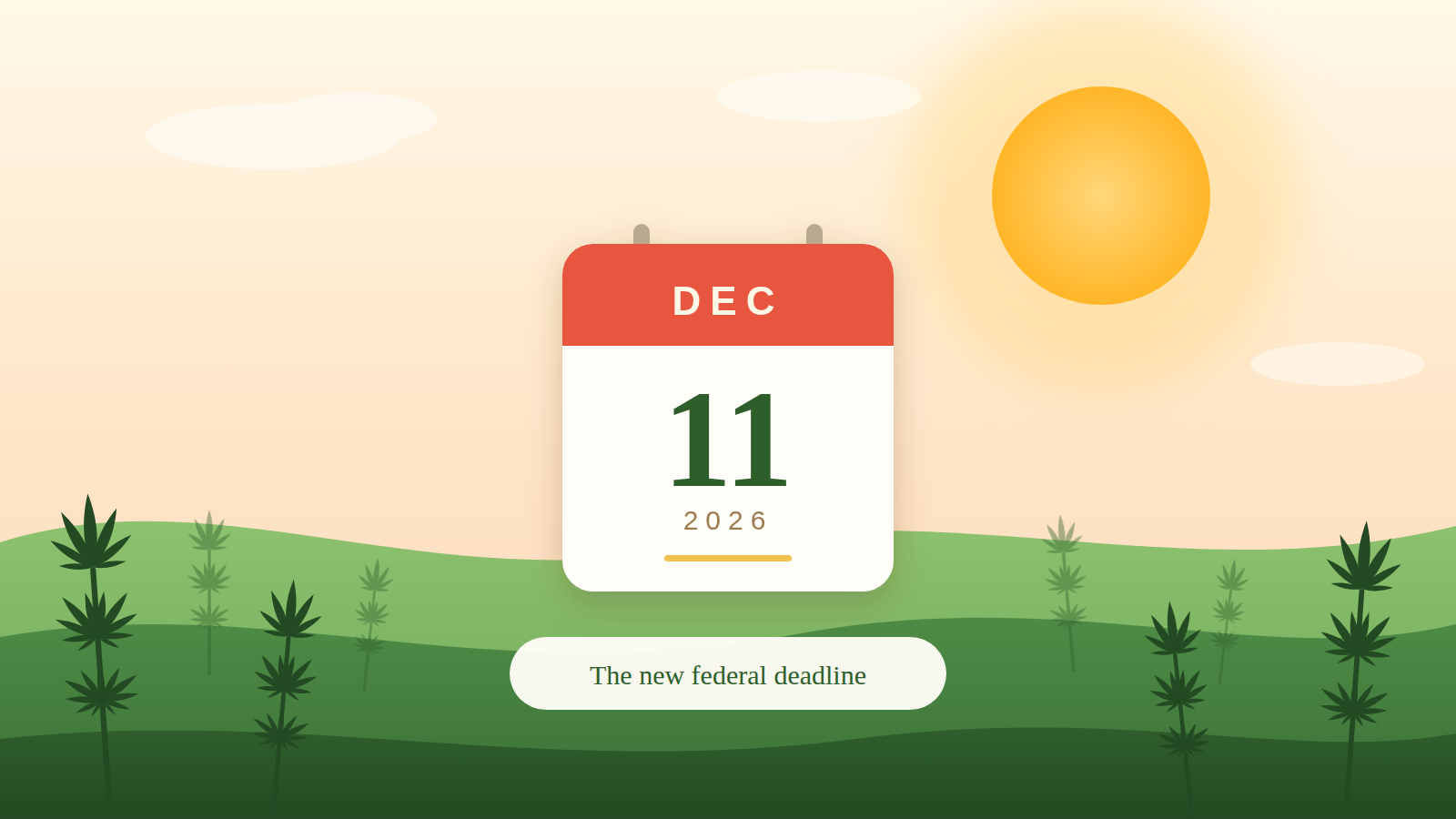
CBD is not an intoxicating cannabinoid and it is not what this law is aimed at. What determines whether a given product survives December 11 isn’t whether it contains CBD — it’s how much total THC is in the container. Which means the answer depends entirely on which of three formulas your gummies are made from.
| Formula | What’s in it | Where it stands under the new cap |
|---|---|---|
| Full Spectrum | CBD plus the plant’s other cannabinoids, including trace THC under 0.3% by dry weight. | Most exposed. Trace THC across a whole jar can easily exceed 0.4 mg per container, even in a product no one would call intoxicating. |
| Broad Spectrum | CBD plus supporting cannabinoids and terpenes, with THC removed after extraction. | Well positioned. Keeps the fuller plant profile without carrying the THC that triggers the cap. |
| THC-Free / Isolate | Purified CBD with THC removed to non-detectable levels. | Least affected. Nothing in the formula runs up against the ceiling. |
Here’s the quiet irony a lot of coverage misses. This law was written to stop 100 mg delta-8 gummies at gas stations. But because the cap is measured per container instead of per serving, it also catches gentle, non-intoxicating full spectrum wellness products that have been sold responsibly for years. Whether the FDA’s forthcoming guidance softens that — the agency still hasn’t defined what a “container” even is — remains an open question.
If you take CBD as part of your daily routine, here’s what I’d actually do with this information.
Look for one of three words: full spectrum, broad spectrum, or THC-free. If it doesn’t say — that alone tells you something about the company.
A good brand publishes third-party lab results for every batch, and a good COA lists total THC, not just delta-9. If you can’t find a COA in under a minute, that’s your answer.
I know the instinct. But gummies have a shelf life, cannabinoids degrade with heat and light, and a stockpile bought in a hurry is usually a stockpile of the wrong thing. Buying thoughtfully beats buying frantically.
Everyone responds a little differently, and finding what works for you takes a few weeks, not a few days. Give yourself the runway to experiment while you still have every option in front of you.
Federal law sets a floor, not a ceiling. States are moving on their own timelines, and some are stricter than what Congress passed.
We didn’t build this brand around loopholes, so we’re not scrambling to close any. Our gummies are made with USDA organic ingredients, they’re vegan, and every batch is double lab tested — and we already offer broad spectrum and THC-free options built to meet the standard the new law sets.
We’re watching the September 30 funding deadline and the FDA’s guidance closely, and if anything about our formulas or labels needs to change, you’ll hear it from us plainly and early. That’s the deal.
Not because they contain CBD. A finished product becomes non-compliant if it holds more than 0.4 mg of total THC per container — which puts full spectrum formulas at risk and leaves broad spectrum and THC-free options largely unaffected.
Synthetically produced cannabinoids, including delta-8, lose federal hemp status on November 12, 2026. That piece was not delayed.
The Senate’s December 11 delay still needs the House to agree, and the White House has said it doesn’t support further extensions. Possible, but I wouldn’t build a plan on it.
CBD itself isn’t typically what tests screen for, but full spectrum products contain trace THC, which can accumulate. If testing is a concern for you, broad spectrum or THC-free is the more sensible choice — and always talk with your healthcare provider.
Spectrum type, total THC on the COA, batch-level third-party testing, and a company that answers the phone. Those four things have always mattered. This law just made them impossible to ignore.
Regulation is uncomfortable, and this one is going to be genuinely hard on a lot of small businesses. I don’t want to be glib about that.
But I’ll tell you what I told my sister when she called about it: the version of this industry that survives December 11 is the version that was already doing it right. Testing every batch. Naming what’s in the jar. Choosing organic ingredients because it costs more and matters more.
Your gummies aren’t going anywhere. Read your labels, ask for your lab results, and go pour that coffee back into the microwave.
— With warmth, from all of us at Feel Good Edibles
If you’ve seen a headline this month telling you your CBD gummies are about to be outlawed, take a breath....
Discovery and Early Research Cannabinol was the first cannabinoid to be isolated from cannabis. British chemists Thomas B. Wood, W....
In the ever-evolving landscape of cannabis science and consumer understanding, a term that’s gaining increasing prominence is TAC, or Total...