
If you have ever opened a lab report and felt your eyes glaze over, you are not alone. Learning how to read a CBD gummy COA can feel technical at first. The good news is that it becomes much easier once you know which parts matter most.
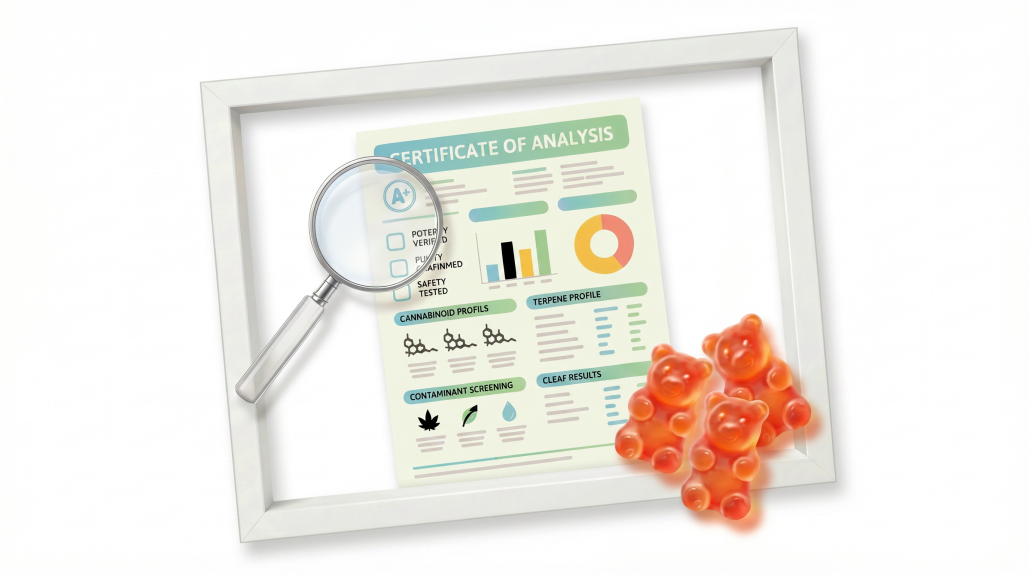
A COA, or Certificate of Analysis, is the lab report that shows what is inside a CBD gummy and what is not. It can help you confirm CBD strength, check THC levels, and see whether the product was screened for contaminants. When you know how to read a CBD gummy COA, you can shop with more confidence and fewer surprises.
This guide breaks the process into simple steps. You do not need a science background. You only need to know what to compare, what to question, and which details deserve a closer look.
What is a CBD gummy COA?
A CBD gummy COA is a third-party laboratory report for a specific product or batch. It is designed to show test results for cannabinoids and, in many cases, contaminants such as heavy metals, pesticides, residual solvents, and microbes. Public health and consumer education sources continue to advise buyers to review third-party testing before purchasing CBD products because labels do not always tell the full story.1 2
In plain language, the label tells you what the brand promises. The COA tells you what the lab found. That is why understanding how to read a CBD gummy COA is one of the smartest habits a careful shopper can build.
| COA section | What it shows | Why it matters |
|---|---|---|
| Cannabinoid profile | CBD, THC, and sometimes minor cannabinoids | Helps confirm whether the formula matches the label |
| Potency | Total milligrams and sometimes per-serving amounts | Shows how strong each gummy may be |
| Contaminant screening | Pesticides, heavy metals, solvents, and microbes | Shows whether the product was checked for quality risks |
| Lab details | Lab name, batch or lot number, and test date | Helps you confirm the report is current and traceable |
Start by matching the COA to the gummy
The first step in how to read a CBD gummy COA is simple. Make sure the report belongs to the product in your hand. Look for the product name, batch number, lot number, SKU, or another identifier that ties the report to the exact gummy you are buying.
If the report does not clearly match the product, stop there. A clean-looking COA is not useful if it belongs to a different batch, a different flavor, or a different formula. The date matters too. An old report may not reflect the current product being sold.
Check the CBD amount per gummy
Next, look for the cannabinoid section. This is usually where you will find CBD and THC results. When shoppers ask how to read a CBD gummy COA, this is often the part they care about most because it speaks directly to serving strength.
Start with the brand’s label claim. Then compare that claim with the lab result. If a jar says each gummy contains 25 milligrams of CBD, the numbers on the report should support that claim in a reasonable way. The math may be shown per gummy, per serving, per gram, or per package, so take a moment to see which format the lab used.
Project CBD advises consumers to look for clear per-serving information, not just a large total number for the whole jar.1 That advice matters because a total container number can sound impressive while still making it hard to understand the actual serving size.
| Label question | What to compare on the COA | Good sign |
|---|---|---|
| How much CBD is in one gummy? | Total CBD compared with serving count | The reported amount supports the stated serving strength |
| Is THC present? | THC line items in the cannabinoid profile | The result matches the product description |
| What type of formula is this? | Presence or absence of multiple cannabinoids | The pattern fits full-spectrum, broad-spectrum, or isolate claims |
Read the THC lines carefully
Another important part of how to read a CBD gummy COA is learning to slow down at the THC section. Many shoppers want a product that fits neatly into daily life. They want consistency and they want to know what to expect.
The National Center for Complementary and Integrative Health warns that some over-the-counter CBD products may contain more THC than expected or may not match their labeling.2 That is why the THC lines deserve close attention, especially when a product is marketed as THC-free or broad-spectrum.
If a brand makes a strong claim, the COA should support it clearly. If the label sounds certain but the lab report feels vague, that is a reason to pause and ask more questions before buying.
Do not skip contaminant results
Many people think a COA is only about potency. It is not. A big part of how to read a CBD gummy COA is checking what should not be in the gummy. That includes pesticides, heavy metals, residual solvents, and microbial contaminants.
Consumer health sources note that contamination remains a concern in parts of the CBD market.2 1 A trustworthy report should make it reasonably easy to see whether the product passed or whether any category raised concerns.
Not every lab formats results the same way. Even so, the basic takeaway should be clear. You want to see a report that looks complete, current, and easy to follow.
| Contaminant category | Why it matters | What you want to see |
|---|---|---|
| Pesticides | Residues can remain if cultivation or processing is poor | Pass or non-detect when applicable |
| Heavy metals | Metals may enter through soil or manufacturing exposure | Pass or within accepted limits |
| Residual solvents | Some extraction methods can leave chemical traces | Pass or non-detect when applicable |
| Microbial screening | Helps identify certain biological contamination risks | Pass when tested |
Look at the lab name, batch number, and date
A CBD gummy COA should feel traceable. That means the report should usually include the lab name, the sample or batch identifier, and the date of testing. These details help you decide whether the report is tied to the current product and whether the information is still relevant.
Think of it this way. A strong report attached to the wrong batch is still the wrong report. A report from long ago may also tell you very little about the item being sold today.
A simple five-step method for how to read a CBD gummy COA
If you want a quick routine, use this five-step review every time you shop. It keeps the process focused and prevents information overload.
| Step | What to do | Question to ask |
|---|---|---|
| 1 | Match the report to the product | Does this COA clearly belong to this gummy or batch? |
| 2 | Check CBD potency | Do the lab results support the serving claim on the label? |
| 3 | Review THC results | Do the THC lines match the product description? |
| 4 | Scan contaminant screens | Did the product pass the major safety checks? |
| 5 | Confirm the date and lab details | Is the report recent, specific, and traceable? |
Final thoughts on how to read a CBD gummy COA
Once you know how to read a CBD gummy COA, the report stops feeling intimidating. You do not need to memorize chemistry terms. You just need to check a few essentials: the CBD amount, the THC lines, the contaminant screens, and the details that tie the report to the product.
That small habit can make a big difference. It helps you move past marketing claims and make choices based on documentation, clarity, and confidence.
If a brand makes it easy to find a current, readable COA, that is usually a positive sign. If the report is missing, outdated, or hard to connect to the product, it may be wise to keep looking.
References
1. Project CBD, 10 Tips for Buying CBD
2. NCCIH, Cannabis (Marijuana) and Cannabinoids: What You Need To Know